NAMRU San Antonio conducts Gap-Driven Research for Operations in Extreme Cold
Photo By Burrell Parmer |
Andres Martinez Murillo, lead biomedical engineer for Naval Medical Research Unit......read moreread more
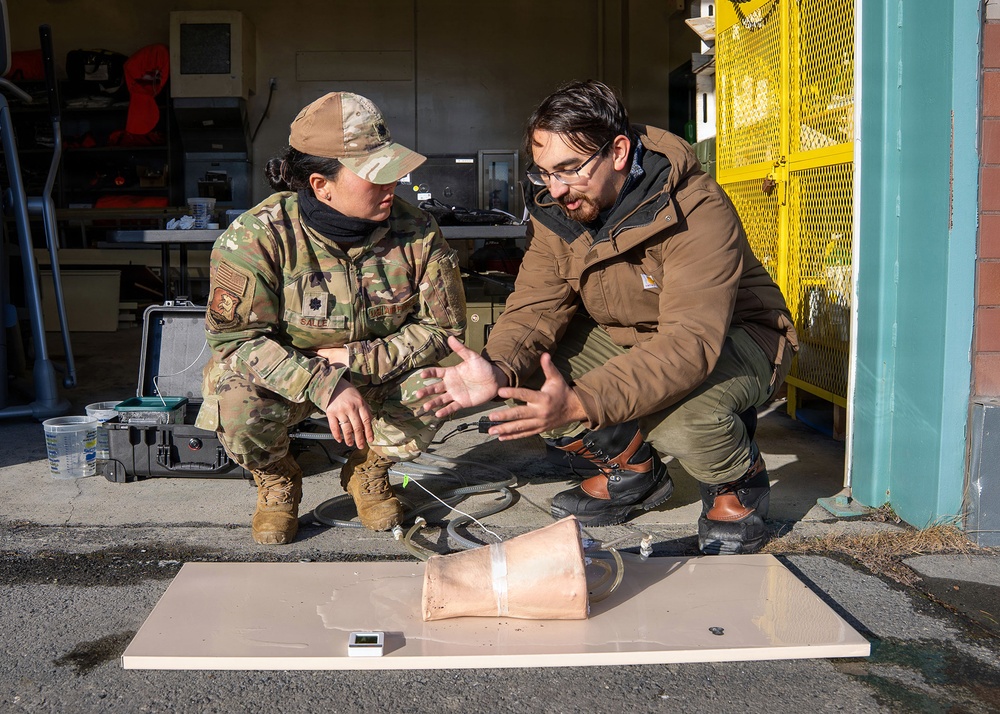
Photo By Burrell Parmer | Andres Martinez Murillo, lead biomedical engineer for Naval Medical Research Unit (NAMRU) San Antonio, explains stability testing on the novel SynDaver thermal, bleeding manikin thigh to U.S. Air Force Lt. Col. Kaitlin Salle at the Kodiak Coast Guard Clinic in Kodiak, Alaska during Arctic Edge 2026, Feb. 26. The novel manikin thigh is meant to keep the circulating ‘blood’ heated to normal body temperature so that researchers can see decompensation of bleeding while exposed to extreme cold. NAMRU San Antonio, part of Navy Medicine Research & Development, conducts gap-driven combat casualty care, craniofacial, and directed energy research in support of Navy, Marine Corps and joint U.S. warfighter health readiness and lethality while engaged in routine and expeditionary operations. (U.S. Navy Photo by MC1 Abigayle Lutz/Released) see less
| View Image Page
NAMRU San Antonio conducts Gap-Driven Research for Operations in Extreme Cold
JOINT BASE SAN ANTONIO-FORT SAM HOUSTON – (March 16, 2026) – To support the future warfighter, Naval Medical Research Unit (NAMRU) San Antonio researchers took part in Arctic Edge 2026 held in Alaska, Feb. 23 – March 13.
Arctic Edge, a U.S homeland defense exercise demonstrating U.S. military extreme cold weather capabilities in the arctic region, provides the NAMRU San Antonio Biomedical Systems Evaluation and Engineering (BSEE) team with an environment to evaluate medical procedures and devices.
The Arctic region is of increasing interest to the near peer adversaries of the U.S. for its tactical, political and economic advantages. Expansion of U.S. military operations into the Arctic to meet this challenge requires advances in medical sup-port capabilities.
The arctic climate complicates Tactical Combat Casualty Care (TCCC) treatment, as casualties donned with large amounts of clothing layers, can make wound assessment and applying medical care, such as tourniquets, more difficult.
"Arctic Edge is a stark reminder that environmental factors are a key component of the battlespace,” explained Dr. Darrin Frye, chief science director for NAMRU San Antonio. “On Kodiak, the cold itself is a tactical consideration. Our successful integration of research and operational training in this environment has strengthened our strategic partnerships and will increase the lethality and resilience of our forces in maritime and land domains."
To assist U.S. armed forces in extreme cold environments, NAMRU San Antonio is conducting analysis on existing treatment protocols, and evaluating the medical equipment currently in use to ensure it functions properly in the extreme cold. These evaluations took place during the BSEE team’s attendance at Arctic Edge and Ice Camp.
Last year, NAMRU San Antonio released research on one such protocol through “Task Analysis Tool to Evaluate Tactical Combat Casualty Care in the Extreme Cold,” a study published in the Journal of Special Operations Medicine.
The task analysis tool consists of steps in casualty care being broken down into sub-tasks, and then further broken down into rudimentary steps.
For example, applying a chest seal might be broken down into steps including a blood sweep, exposure of the wound, a wound assessment, and then finally the actual chest seal application.
This analysis allows each step of these sub tasks to be graded in a go/no-go style grading form, for the evaluation of “if and why” a step could fail in the extreme cold. This task analysis creates a baseline which future changes to TCCC protocols for cold weather can be tested against, validating the new treatment procedures.
NAMRU San Antonio, in collaboration with Naval Health Research Center, hopes to perform these evaluations with medics in the field during Arctic Edge 2026 to learn where TCCC procedures could be further improved for the extreme cold.
Additionally, NAMRU San Antonio will examine medical equipment and other gear currently in use to ensure it functions properly in polar conditions. The command is focused on testing a large breadth of medical equipment (45 in total, primarily found on the Marine Authorized Medical Allowance Lists) to identify trends and potential points of failure.
“These items were tested in the Cold Regions Research Engineering Labs environmental chambers, in temperatures set at -40 C for further assessment of their specific material characteristics, as well as their accuracy,” explained Andres Martinez Murillo, a BSEE Department biomedical engineer. “The results of these tests illustrated which equipment can be used in the arctic environment, and which equipment must be either replaced or possibly winterized by the manufacturer for future use.”
“The collaboration with our partners in polar medicine and tactical care was not just beneficial; it was essential,” Frye added. “This initiative has produced actionable insights that will directly impact our operational readiness and our ability to provide superior care in the most demanding of cold-weather scenarios."
Previously, presentations of the task analysis tool were briefed to researchers at the 2025 Military Health System Research Symposium, as well at the 2025 Below Zero Medicine Conference. A technical manuscript is available via the Defense Technical Information Center.
“As one of the eight research commands within Navy Medicine Research & Development (NMR&D), NAMRU San Antonio routinely showcases its capabilities at various conferences through exhibits and presentations,” said Martinez Murillo. “This has led to support from Special Operations Command to conduct further cold cycling and extreme cold evaluations on special operation forces medical kits, an ongoing project. This opens the door for the future growth of collaborations for research in the development of solutions that will advance warfighter readiness and treatment.”
NAMRU San Antonio, part of NMR&D conducts gap-driven combat casualty care, craniofacial, and directed energy research in support of Navy, Marine Corps and joint U.S. warfighter health readiness and lethality while engaged in routine and expeditionary operations.